
2023 Report of the Economic Survey
In This Section
The bi-ennial Report of the Economic Survey is one of the premier and most sought-after publications of the Association. The Economic Survey’s results are often cited in judicial opinions, analyzed by research firms, and used by law firms. Current AIPLA members can access the Report online - for free! You must log in to access the digital file. When you open the file in PDF, you can display the bookmarks to more easily navigate to the specific information in the Report.
Order a print copy of the Report of the Economic Survey.
We are always looking to make the Report as timely and relevant to practitioners, as such, we have made a number of changes and enhancements. As we continue to emerge from the pandemic, questions related to COVID-19 were removed or revised. One new question asked about the number of miles between respondents’ remote work location and their office location. We added new categories to some questions. More specifically, privacy/cybersecurity was added to the question that reports the percentage of time devoted to various practice areas, and design was added as a category for the technical specialization time spent.
- Remote work percentages in 2023 were projected to be similar to 2022, but office attendance increased.
- Median gross income and billed hours of respondents decreased.
- Average hourly billing rate for private firm attorneys remained unchanged.
- Median charges for US patent applications increased by about 10% in 2022 compared to 2020.
- US trademark application charges increased year over year, but prosecution costs for both patent and trademark applications stayed the same.
- Over 70% charge a fixed fee for initial trademark applications.
- Median patent litigation costs varied in 2022 based on the amount at risk - increasing for cases with $1-25 million at risk but decreasing for cases with more than $25 million at risk.
- Median trademark litigation costs generally increased for cases with over $1 million at risk in 2022.
- There was an upward trend in salaries from 2020 to 2022 among private practice partners and solo practice practitioners, as well as for first-year associates
- typical charges for law services,
- typical types of fees for law-service charges,
- typical costs of litigation, and
- characteristics of firms.
Note: The online edition of the Report is protected from copying, editing, and printing. We know that members may need specific pages for court filings and we hare happy to provide specific pages for such use upon request. If you are in need of specific tables to submit, please contact agordon@aipla.org, and state the purpose for needing the tables, and the specific tables (page numbers) needed.
Upcoming Events
-
2026 AM IP Practice in Japan Pre-Meeting
October 27 to 28, 2026
The Pre-Meeting is open to all and is a great event for networking with colleagues from Japan and other countries. Presentations will be provided by the speakers from AIPLA, the Japan Patent Attorney Association (JPAA), and possibly from the International Association for the Protection of the Intellectual Property in Japan (AIPPI-J), Japan Trademark Association (JTA) and Japan Patent Office (JPO) on a range of topics -
.png?sfvrsn=ababee26_1 "AM26 Sq (1)") AIPLA 2026 Annual Meeting
AIPLA 2026 Annual Meeting
October 29 to 31, 2026
-
2026 Annual Meeting
October 29 to 31, 2026
-
 AIPLA CLE Webinar: Discovery in AI Patent Litigation
November 10, 2026 1:00 PM to 2:30 PM | Up to 90 Minutes CLE Eligible
-
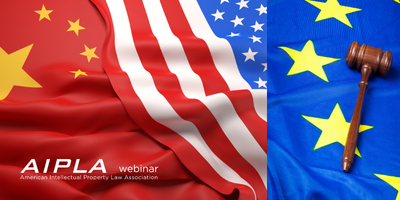 AIPLA CLE Webinar: Data and Market Exclusivity: An Update on China’s New Law and Comparisons to the US and Europe
November 19, 2026 10:30 AM to 12:00 PM | Up to 90 Minutes CLE Eligible