
Innovate Articles
Securing Autonomous Drone Logistics: What IP Practitioners Need to Know About AI-Driven UAV Systems
Praveen Manimangalam
The Rise of Autonomous Drone Logistics and Why IP Matters Now
Autonomous drone logistics has moved rapidly from experimental pilot programs to operational reality. Drones are increasingly deployed for emergency medical delivery, disaster response, infrastructure inspection, and time-critical logistics. As artificial intelligence (AI) increasingly governs how these systems prioritize missions, navigate constrained airspace, and secure sensitive payloads, intellectual property (IP) considerations have become both more complex and more valuable.
For IP practitioners, autonomous UAV logistics represents a convergence of protectable domains: artificial intelligence, cybersecurity, aviation systems, and distributed decision platforms. Yet many innovators struggle to effectively protect inventions in these domains. Software-only claims risk eligibility challenges. Hardware-centric claims are often crowded with prior art. Poorly framed AI disclosures can also raise enablement concerns. As a result, the most valuable inventions in this field frequently remain under protected.
This article examines how modern AI-driven drone logistics systems function, why their value lies at the system level rather than in individual components, and how IP professionals can craft strategies that align with current patent eligibility and enforcement realities.
Autonomous Drone Logistics: Beyond “Flying Robots”
At first glance, drone logistics appears simple: an autonomous drone or unmanned aerial vehicle (UAV) transports a payload from point A to point B. In practice, however, advanced autonomous logistics systems operate as distributed decision networks rather than independent vehicles.
Modern platforms must simultaneously manage mission prioritization, dynamic routing, security verification, operational resilience, and regulatory compliance. Emerging governance frameworks for autonomous and agentic AI systems are also increasing the importance of traceability, accountability, and human oversight in operational decision architectures1. These requirements are shaped in part by oversight from the Federal Aviation Administration (FAA), which emphasizes safety, traceability, and accountability in autonomous operations2.
As a result, innovation has shifted away from airframes and sensors toward AI-enabled orchestration layers. These layers evaluate competing missions, allocate fleet resources, and enforce authorization rules across multiple drones and locations. From an IP perspective, this architectural shift is critical: it is the orchestration logic, not the drone itself, that increasingly defines commercial value.
How AI-Driven UAV Logistics Systems Actually Work
Figure 1. High-level system architecture of an AI-driven autonomous drone logistics platform, highlighting integrated mission management, security, and routing functions.
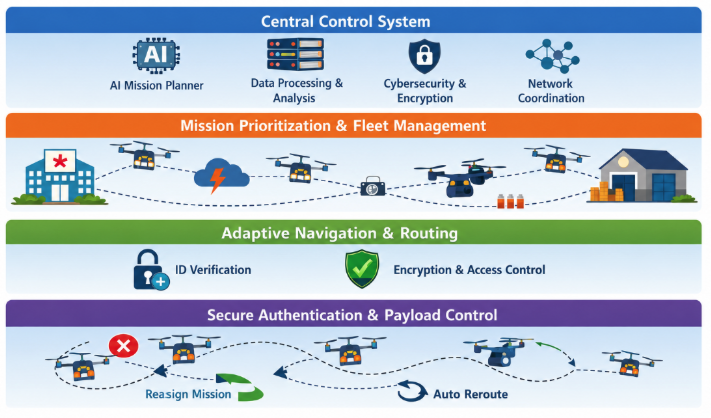
Intelligent Mission Prioritization.
Advanced systems assess mission urgency, environmental risk, payload sensitivity, and resource availability to determine execution order. This enables emergency or safety-critical deliveries to preempt routine operations without human intervention.
Adaptive Navigation and Routing.
AI-based routing engines dynamically adjust flight paths in response to weather conditions, airspace constraints, and operational disruptions. Importantly, routing decisions are often coordinated at the system level, allowing fleets to operate cooperatively rather than competitively.
Secure Authorization and Payload Control.
To prevent misuse or interception, modern platforms validate missions, vehicles, and recipients using cryptographically protected authorization mechanisms. Payload release occurs only after successful verification, creating auditable security checkpoints throughout the mission lifecycle.
Distributed Resilience and Failover.
If a drone becomes unavailable, missions may be reassigned or rerouted automatically. This transforms autonomous logistics from a collection of vehicles into a resilient operational network.
These subsystems do not operate independently. Their value arises from coordinated interaction, a fact that has significant implications for patent drafting and claim scope.
Patentability Challenges in AI-Driven UAV Systems
AI-enabled logistics platforms face recurring patentability hurdles.
Subject Matter Eligibility.
Claims directed solely to abstract decision-making or generalized data processing risk rejection under current eligibility frameworks3. Successful claims emphasize specific technological improvements, such as enhanced operational safety, reduced mission failure rates, or improved authorization integrity in autonomous flight systems.
Enablement and Written Description.
AI claims must describe how models interact with mission data, constraints, and system feedback. Vague references to “machine learning” without operational detail may be insufficient to demonstrate possession of the invention4.
Component-Focused Claiming.
Hardware-only drone claims often encounter dense prior art. System-level claims covering orchestration, prioritization, and secure coordination frequently provide stronger protection, although proving infringement of such claims may require access to information about the broader operational system rather than examination of the drone alone.
Interdisciplinary Prior Art.
Relevant prior art extends beyond aviation into distributed systems, cybersecurity, and AI-based decision engines. Comprehensive searches must reflect this breadth.
Strategic Claim Drafting Lessons for IP Practitioners
Several best practices are emerging.
Claim Integrated Systems.
Framing inventions as coordinated platforms combining data ingestion, prioritization logic, authorization controls, and fleet management helps establish technical improvement rather than abstract reasoning.
Anchor Claims to Operational Outcomes.
Claims tied to measurable improvements, such as reduced response time or enhanced payload security, align more closely with eligibility guidance and enforcement standards.
Use Layered Claim Sets.
Robust portfolios typically include independent system claims, method claims covering mission orchestration, and dependent claims directed to security or compliance features.
Balance Patents and Trade Secrets.
Some AI elements, such as training data or internal weighting parameters, may be better protected as trade secrets where reverse engineering risk is low.
Why This Matters Now
Autonomous drone logistics is moving toward critical infrastructure status in healthcare, disaster response, and public safety. As investment accelerates, intellectual property will increasingly shape market leadership and access.
For IP practitioners, this field presents an opportunity to influence protection strategies early in the technology lifecycle. Those who recognize that value lies in AI-driven system coordination rather than individual drone components will be better positioned to secure durable, defensible IP rights.
Key Takeaways for AIPLA Practitioners
Autonomous UAV logistics systems function as AI-governed networks, not standalone devices
The most valuable innovations reside in prioritization, security, and coordination layers
Effective patent strategies emphasize system-level integration and operational improvement
Early, thoughtful IP planning can significantly shape competitive advantage
As autonomous systems continue to scale, intellectual property will play a decisive role in determining which platforms become foundational and which remain peripheral.
Transparency Disclosure
The author is the inventor of technologies referenced in this article and has been involved in related patent filings. No litigation or administrative proceedings related to these technologies are currently pending.
Article Summary
This article examines how AI-driven autonomous drone logistics systems are reshaping emergency response and delivery operations while introducing new challenges for intellectual property protection. It highlights innovations in mission prioritization, secure authorization, and system-level coordination, explaining why these capabilities, rather than individual drones, increasingly represent the most defensible sources of IP value. The article also provides practical guidance for IP practitioners drafting and prosecuting patents in AI-enabled, multi-domain systems.
Praveen Manimangalam is a Doctor of Business Administration (DBA) candidate at Florida International University, specializing in the intersection of artificial intelligence, enterprise systems, and business performance. With over 18 years of global experience across the United States, India, Africa, and Asia, he has led large-scale digital transformation initiatives as a Product and Project Manager across industries including education, healthcare, energy, and enterprise technology.
His work focuses on how AI is reshaping enterprise decision-making, data governance, and intellectual property protection—particularly in the context of trade secrets and AI-driven systems. He has filed patents applications in areas including agentic CRM architectures and autonomous systems and is pursuing formal training in intellectual property law to strengthen his expertise at the intersection of technology and legal frameworks. His research has been published and presented at IEEE, IEOM, AAAI, and CognoCon, and he serves as a Session Chair for INFORMS. Praveen actively contributes to professional communities including AIPLA, IEEE, ACM, and INFORMS, and brings a practitioner-driven perspective to how organizations can effectively protect and leverage innovation in the age of AI.