
Innovate Articles
Protected? A Look at Trademark Law's Landmark Decisions Applied to Sports Video Games[1]
Louis Juliano & Olivia Farneski
The rise of digital media, especially in sports video games, has complicated the scope and enforcement of trademark law. Sports video games are a growing cultural phenomenon. Many gamers have envisioned playing as a world-class athlete.
Touchdown! Sports video games, such as FIFA/FC and Madden, allow fans to assume the roles of their favorite athletes playing simulated matches using their likeness. Fans relate to the excitement; screaming at their screens in hopes, playing as their favorite stars, they will make the heroic strike to win the championship. Goal!
With these video games, the fan is now in control. Using a recreated avatar of their favorite athletes, gamers can participate in match scenarios with their favorite players.
However, trademark law applies in sports themed video games that use the jerseys, logos, and team names from their respective IP holders. This article analyzes how the scope of developer’s rights has changed following certain landmark trademark decisions.
Rogers v. Grimaldi
In 1989, the Second Circuit decided Rogers v. Grimaldi, asking if the First Amendment allows the use of a celebrity’s name in an expressive work.[2] The central issue was whether the title “Ginger and Fred” deserved First Amendment protection or misled consumers into believing the movie was endorsed by famous actors Ginger Rogers and Fred Astaire “in a direct, biographical sense.”[3] Yet because “Ginger and Fred” was truthful in the name of the film’s fictional characters “Ginger” and “Fred,” the Court found the title to be protected under the First Amendment. Specifically, the court noted that “the risk of misunderstanding, … is so outweighed by the interests in artistic expression as to preclude application of the Lanham Act.”[4]
In ruling for the film company, the Second Circuit created the Rogers test, asking (1) if the use of the mark “has no artistic relevance to the underlying work”, and (2) that it “explicitly misleads as to the source or the content of the work.”[5] with broad protection offered to those potentially infringing upon the trademark holder’s rights. Rogers notes that for free expression in titles, titles “are of a hybrid nature, combining artistic expression and commercial promotion.”[6] While a title might be just for the creator’s expressive intent, titles in film additionally have substantial marketing benefits.[7]
Section 43(a) of the Lanham Act protects the public’s interest in being free from consumer confusion about affiliations and endorsements; however, this protection is limited by First Amendment.[8] Rogers sought to effectively balance the interests of Section 43(a) and the public’s interest in freedom of expression under the First Amendment.
Brown v. Electronic Arts
In 2013, the Rogers test was applied in the field of sports themed video games in Brown v. Electronic Arts.[9] Jim Brown was a star player for the Cleveland Browns from 1957-1965 and was later inducted into the National Football League (NFL) Hall of Fame.[10]
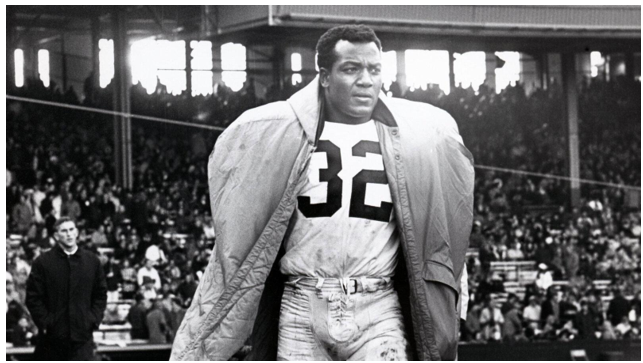
The Ninth Circuit applied the Rogers test when Brown contested his likeness being used in the popular Electronic Arts (EA) video game, Madden NFL, without his consent.[11]
EA’s Madden NFL simulated football games and included avatars of current and former NFL players. A football fan was able to choose from a variety of historical football teams and popular players, recognizable by their visual attributes.
Brown brought suit claiming the EA’s use of his likeness violated Section 43(a) of the Lanham Act.[12] The District Court determined that Madden games are expressive works that are entitled to First Amendment protections.[13]
The Ninth Circuit affirmed the District Court’s decision.[14] The Court explained that because Madden contains enough elements to warrant a First Amendment consideration, “no version of Madden NFL” is undeserving of protection as an expressive work.[15] Expressive works "communicate ideas and even social messages through familiar literary devices”, like characters, dialogue, and music.[16] Expressive works are awarded First Amendment protection because they are critical to advance social progress and essential to a robust “marketplace of ideas.”[17] Otherwise, trademark holders would restrict usage of words otherwise protected by the First Amendment, which extends past the purposes of the Lanham Act. The Court further stated that “every version… features characters, dialogue, plot, and music… interaction between the virtual world of the game and individuals playing the game is prevalent.” [18]
In applying the Rogers test, the Ninth Circuit concluded Brown did not make persuasive arguments on either prong. First, the Court found that the use of Brown’s likeness in Madden NFL was artistically relevant, as avatars of real athletes are essential to the game and Brown is one of NFL’s greatest players.[19] As to the second prong, Brown did not make an argument that EA explicitly misled consumers as to his involvement in the game.[20] In sum, the Court found that the Rogers test was the appropriate framework and Jim Brown failed to allege facts that showed EA misled consumers about his endorsement or involvement.
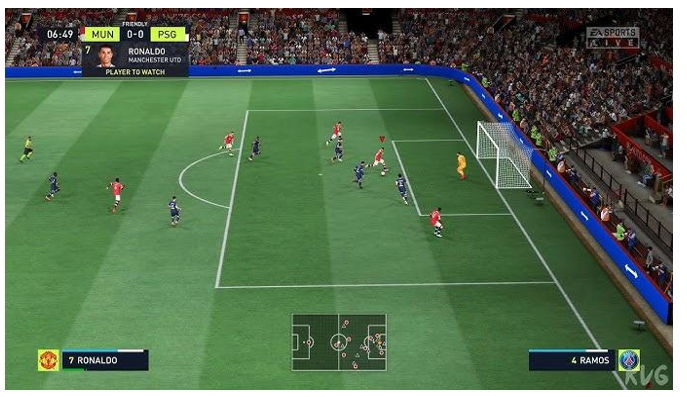
This decision heralded an embrace of sports themed video games as expressive works, giving them freedom to use recognizable likeness of real world athletes and their accompanying teams. Following Rogers, and as seen in Brown, uses in expressive works extend beyond just titles in movies. As seen in the screen capture below, a typical FIFA/FC user’s experience looks similar to the photo below, taken from FIFA 22.[21]
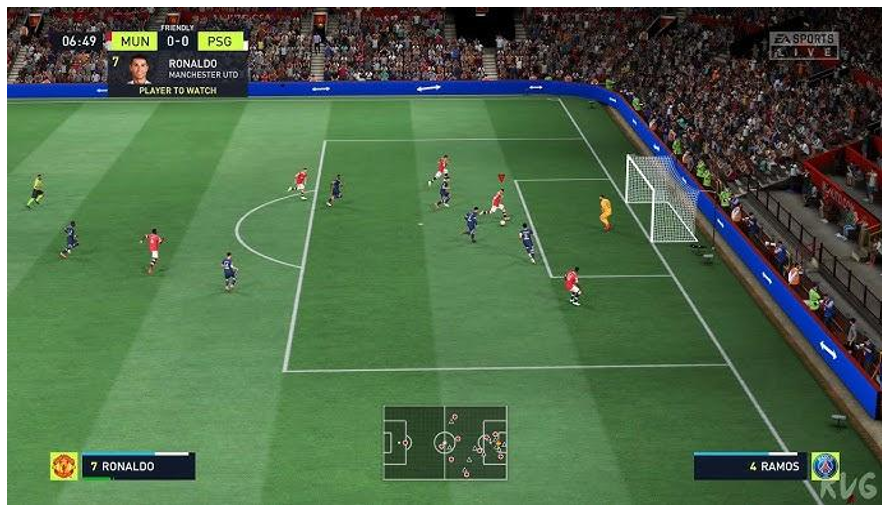
Under Brown and Rogers, a new developer can make a game that uses recognizable avatars of individual players such as FIFA 22 in the photo above, so long as the use is an “expressive work” that was not meant to “explicitly misleads as to the source or the content of the work.”[22] As noted above, under Brown video games are expressive works.[23] Thus, the central focus asks if the work explicitly misleads buying consumers as to the source or the content of the work.[24] In the sports video game scenario, this would ask whether those who watch a team like Manchester United would be confused as to Manchester United being the source of the soccer. Yet trademark law under Rogers and Brown suggests that the inclusion of teams would be protected to the inclusion in the game alone, so long as it does not explicitly signal endorsement and is artistically relevant to the authenticity of the game, such as resembling a real soccer simulation, as artistic expression protected under the First Amendment.
Jack Daniel’s Props. v. VIP Prods. LLC
The role of the Rogers test in Trademark protection was narrowed by the Supreme Court in Jack Daniel’s Props. V. VIP Prods. LLC.[25] But the Supreme Court remained unanswered about noncommercial uses for the Rogers test, instead holding that the Rogers test does not apply where the defendant’s “use of a mark is as a mark”.[26]
Suppose a new company creates a soccer video game. This might entail using Paris Saint Germain’s (“PSG”) kit. However the game itself is trademarked as a whole and the real life likenesses of the teams are a small, noncommercial portion of the game. Take the same photo used above detailing FIFA 22 gameplay, and the typical user experience. Using a generative AI tool, one can create the same photo with all jerseys turned blank. A user would then see this:
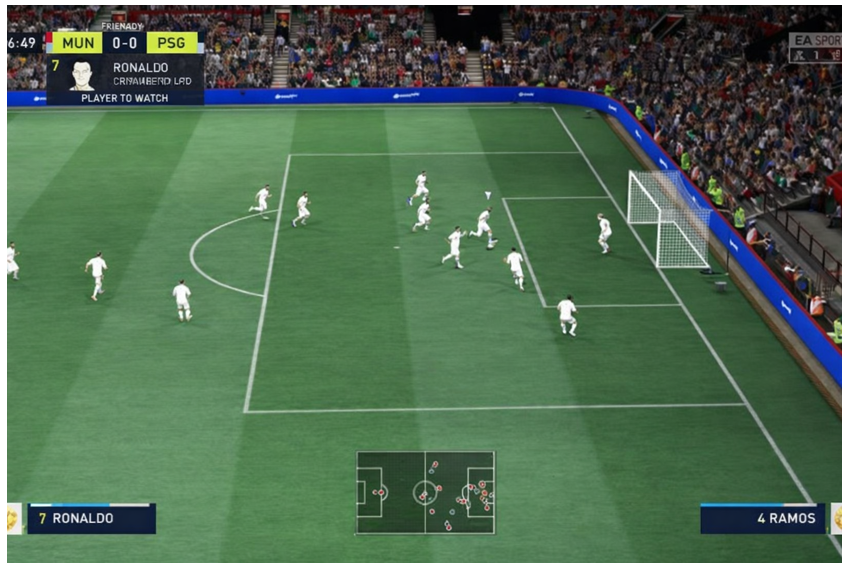
Applying Rogers and Brown to this photo in a post Jack Daniel’s world, PSG and Manchester United should be protected as free speech under the First Amendment to permit more developers to create expressive works. So long as the new game is not advertised in commercials using PSG’s or Manchester United’s likeness it seems as if the use would be granted.
Let's say a game is marketed as such: the first photo below is an example of a licensed use for the FIFA 22 cover (for the standard edition version).[27]
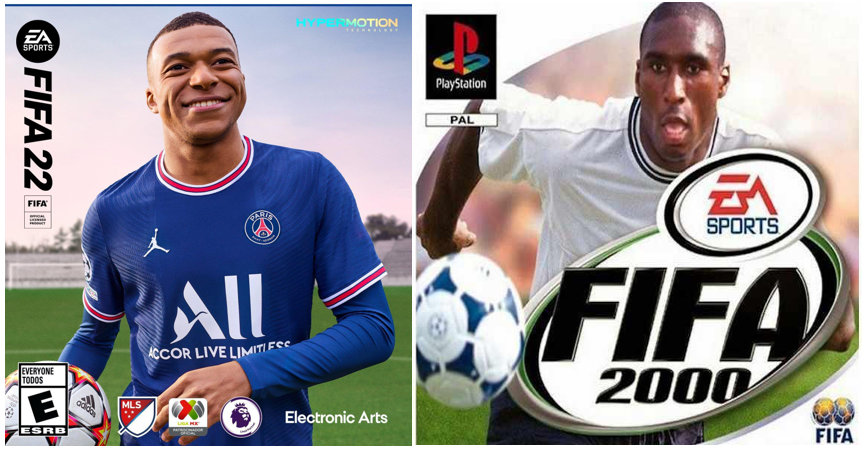
The cover clearly indicates the PSG trademark and “explicitly misleads as to the source or the content of the work.”[28] Because customers who see this game would believe that PSG endorses this product, since their mark is broadly displayed on the front cover, and would not be subject to protection under Rogers or Jack Daniel’s. Thus, unless they paid PSG a licensing fee, Electronic Arts would not be permitted to use PSG’s kit on the cover.
Compare this with the second photo above of the FIFA 2000 game. This cover, with Tottenham Hotspur F.C. 's Sol Campbell, shows no trademarked features within would pass Rogers and Jack Daniel’s, barring any player rights issue. Thus, because the game is not endorsing Tottenham Hotspur F.C. 's likeness, the use would be permitted.
But what of the match kits? Returning to the photos above, as an expressive work, could this use be permissible?
We think so under Rogers and Jack Daniels. Simply, the trademarked elements are two small and noncommercial to be considered more than an expressive work. But as it stands, companies like Electronic Arts continue to dominate the sports video game industry, such as their extra content revenue from their FIFA 21’s “Ultimate Team” format accounting for 53% of Electronic Arts total extra content revenue from all of its games that year.[29] Hopefully, a balance between antitrust concerns and upholding trademark holders’ rights can be established following Jack Daniel’s.
[1] Oliva Farneski and Louis Juliano, Rutgers Law School, Camden, NJ, Candidates for Juris Doctor degree, May, 2026.
[2] Rogers v. Grimaldi, 875 F.2d 994 (2d Cir. 1989).
[3] Rogers, 875 F.2d at 1001.
[4] Id.
[5] Id. at 999; See also Jack Daniel’s Props. V. VIP Prods. LLC, 599 U.S. 140, 150-151 (2023).
[6] Rogers, 875 F.2d at 998.
[7] Id.
[8] Lanham Act, 15 U.S.C. §§ 1125.
[9] Brown v. Electronic Arts, Inc., 724 F.3d 1235 (9th Cir. 2013).
[10] Richard Goldstein, Jim Brown, Football Great and Civil Rights Champion, Dies at 87, N.Y. Times (May 19, 2023), https://www.nytimes.com/2023/05/19/sports/football/jim-brown-dead.html.
[11] Brown 724 F.3d at 1240.
[12] Id. at 1240.
[13] Id. at 1238-1239.
[14] Id.
[15] Id. at 1241.
[16] Brown v. Entm't Merchs. Ass'n, 564 U.S. 786, 790 (2011).
[17] Foundation for Individual Rights and Expression, Arguments for Freedom: The Many Reasons Why Free Speech Is Essential (Nov. 1, 2022), https://www.fire.org/news/arguments-freedom-many-reasons-why-free-speech-essential
[18] Brown 724 F.3d at 1241.
[19] Brown 724 F.3d at 1247.
[20] Id. at 1248.
[21] FIFA 22 Gameplay (PC UHD) [4K60FPS], YouTube (Throneful), https://www.youtube.com/watch?v=XlrJ_urwp-Y (last visited Apr. 6, 2026).
[22] Rogers, 875 F.2d at 999; See also Jack Daniel’s, 599 U.S. at 150-151.
[23] Brown, 724 F.3d at 1248.
[24] Rogers, 875 F.2d at 999; See also Jack Daniel’s, 599 U.S. at 150-151.
[25] 599 U.S. 140 (2023).
[26] Id. at 163.
[27] FIFA 22 – PlayStation 5, Amazon, https://www.amazon.com/FIFA-22-PlayStation-5/dp/B098KS12NL (last visited Apr. 6, 2026).
[28] Rogers, 875 F.2d at 999.
[29] FIFA Ultimate Team Revenue in FY 2021 – $1.62B; 53% of EA’s Total Extra Content Revenue, Focus on Business (July 8, 2021), https://focusonbusiness.eu/en/news/fifa-ultimate-team-revenue-in-fy-2021-1-62b-53-of-ea-s-total-extra-content-revenue/4235
Olivia Farneski
I am a Rutgers Law School J.D. 2026 Candidate, interested in pursuing a career in Intellectual Property. After graduating, I will be clerking in Ocean County for Judge Craig Wellerson. I am particularly interested in Trademark law and Trade Secrets. I recently competed in the INTA Saul Lefkowitz Moot Court Competition, alongside Mr. Juliano.
Louis Juliano
I am a Rutgers Law School J.D. 2026 Candidate, seeking to work in Intellectual Property following my clerkship in Monmouth County with Judge Jason Rockwell. Specifically, I seek to work in Trademark and Copyright law, with some room left for Antitrust and Commercial law. I have been published in the AIPLA QJ for my note on the Dewberry Decision in 53 AIPLA Q.J. 483. I have written a second note for publication taking an alternative approach to the article below, looking through an antitrust lens on sports video games and exclusive licensing deals, which I hope to publish in a journal following this article. Ms. Farneski and I recently competed in the INTA Saul Lefkowitz Moot Court Competition, arguing in the Eastern District of New York.