

INNOVATE Magazine
INNOVATE is the online magazine by and for AIPLA members from IP law students all the way through retired practitioners. Designed as an online publication, INNOVATE features magazine-like articles on a wide variety of topics in IP law.
The views and opinions expressed in these articles are those of the authors and do not necessarily reflect the views or positions of AIPLA.
Articles
In This Section
The Hidden IP Risks Inside the Manufacturing Floor
Gregory Stone
The Blind Spot on the Shop Floor
When IP counsel sits down with manufacturing clients, the conversation usually centers on patent portfolios, freedom-to-operate analyses, and product designs. But some of the most valuable, and the most vulnerable, intellectual property inside a manufacturing organization has nothing to do with the product itself. Operational innovations may represent a manufacturer’s most significant source of competitive differentiation, yet they are routinely excluded from formal IP programs. It lives in the processes by which products are made: the refined sequences, tooling techniques, and process parameters that operations teams develop over years of hands-on problem-solving.¹ These operational innovations often constitute protectable trade secrets or potentially patentable inventions.² Yet because they often arise informally on the production floor rather than in an R&D lab, they frequently go unrecognized, undocumented, and unprotected until they walk out the door with a departing employee or land in a supplier’s “best practices” guide.
The Legal Landscape: Trade Secrets and Patents
Manufacturing process innovations are protectable under two principal bodies of law. The Defend Trade Secrets Act of 2016 (“DTSA”) and the Uniform Trade Secrets Act (“UTSA”), adopted in 48 states, broadly protect any information that derives economic value from secrecy, provided the owner has taken “reasonable measures” to keep it secret.³ A supervisor’s refined manufacturing sequence, a technician’s tooling adjustment, or an engineer’s method for improving throughput can each qualify, so long as those two requirements are met.
Patent protection is also available for manufacturing processes under 35 U.S.C. § 101, and the Supreme Court in Diamond v. Diehr confirmed that process claims transforming an article to a different state are patent-eligible.⁴ But the Federal Circuit’s decision in American Axle & Manufacturing, Inc. v. Neapco Holdings LLC sounded a warning: patent claims that describe only what a manufacturing process achieves, without specifying how, may be held ineligible under § 101.⁵ In dissent, Judge Moore warned the decision threatened “the type of traditional manufacturing patent . . . which has been eligible for patent protection since the invention of the car itself.”⁶ The deeply divided en banc court denied rehearing over the dissent of six judges, and the Supreme Court declined to intervene.⁷ For IP counsel advising manufacturers, the lesson is significant: when evaluating whether to pursue patent protection for an operational innovation, counsel must assess whether the innovation can be claimed with sufficient specificity as to the concrete steps, structures, or parameters involved, not merely as a functional result. Where the innovation resists that level of specificity, trade secret protection may be the more reliable path.
The practical takeaway: for many operational innovations, trade secret protection will be the more reliable strategy, but only if the legal prerequisites are satisfied. Filing a patent requires public disclosure and offers a finite 20-year term; trade secret protection lasts as long as secrecy is maintained but can be forfeited in an instant.
How Operational IP Gets Lost
The most common way manufacturers lose operational IP is not through corporate espionage; rather, it is through their own failure to recognize and protect it.
Supplier collaborations. Consider an aerospace components manufacturer that develops a proprietary multi-stage titanium heat-treatment sequence producing turbine blades with superior fatigue resistance. When a batch exhibits micro-cracking, the company’s engineers invite their alloy supplier to troubleshoot, sharing detailed heat-treatment data such as ramp rates, hold temperatures, quench timing, atmosphere composition, all over several weeks. The existing supply agreement contains only a general confidentiality clause covering “proprietary information.” After the defect is resolved, the supplier incorporates the insights into a “best practices” guide distributed to competitors.
When the manufacturer consults IP counsel, the news is not encouraging. Courts across multiple circuits have held that general confidentiality clauses, without specific identification of the information to be protected, may be insufficient to satisfy the “reasonable measures” requirement under the DTSA and UTSA.⁸ By contrast, the Third Circuit credited a pharmaceutical manufacturer’s trade secret protections where the company had required specific NDAs with “scientists, vendors, suppliers, and business partners prior to sharing information” and maintained need-to-know access controls.⁹ The lesson is clear: an NDA covering “proprietary information” in the abstract provides far less protection than one identifying specific process parameters.¹⁰
Employee departures. Operational knowledge in manufacturing is frequently embedded in individual experience rather than formal documentation. Consider a specialty chemical manufacturer whose senior production manager spends twelve years developing proprietary polymer extrusion parameters, such as die temperatures, screw speeds, melt pressures, and cooling profiles, that enable the company to produce high-performance tubing with unusually tight tolerances. Those parameters exist only in the manager’s working knowledge and personal notes. The company’s employment agreement contains a confidentiality clause referencing only “customer lists, pricing information, and business plans,” not manufacturing processes or operational know-how. When the manager resigns to join a direct competitor, which within months begins producing tubing with comparable tolerances, the manufacturer discovers it has little legal recourse. Courts have consistently held that employers who never documented their operational know-how as confidential, never included manufacturing processes in their confidentiality agreements, and never implemented access controls face an uphill battle enforcing trade secret rights.¹¹
Unprotected public disclosure. Operational improvements are sometimes presented at conferences or published in trade journals before anyone consults IP counsel. Consider a contract electronics manufacturer whose engineering team develops an innovative automated optical inspection technique using a novel combination of lighting angles, sensor positioning, and algorithmic filtering that dramatically improves defect detection rates. Pleased with the results, the lead engineer presents the technique at a regional manufacturing conference with a detailed slide deck, and the quality director publishes a case study in a trade journal crediting the new method. No patent application is filed. By the time IP counsel learns of the innovation eighteen months later, the one-year grace period under 35 U.S.C. § 102(b)(1) has expired, barring patent protection. ¹² And because the technique has been described in detail publicly, trade secret protection is equally unavailable. ¹³ The company has permanently lost the ability to protect one of its most valuable operational innovations – not because of any adversary’s actions, but because no internal process existed to evaluate the innovation’s IP significance before disclosure.
What IP Counsel Should Do
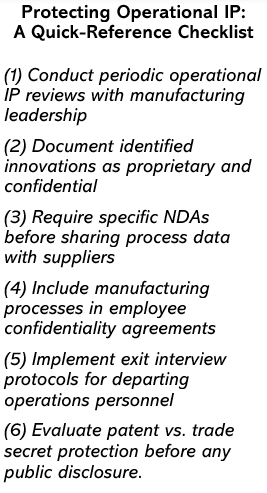
The good news is that addressing these risks does not require complex legal structures. It requires integrating a few targeted practices into your client’s existing workflows. ¹⁴
Build an innovation identification program. Work with manufacturing leadership to establish a simple mechanism for flagging operational improvements. This need not be a formal invention disclosure process. A periodic review, whether quarterly or semiannually, in which operations managers are asked targeted questions can surface innovations that merit IP evaluation: Have you changed any process sequences? Adjusted any equipment settings? Modified any tooling or fixtures? Often, what operations personnel consider routine shop-floor problem-solving is exactly what IP counsel would immediately recognize as a protectable trade secret or patentable invention. The underlying principle is straightforward: an organization cannot protect what it has never identified.
Implement reasonable protective measures. Identification alone is not enough. Courts assess whether the owner took affirmative steps by marking information as confidential, limiting access on a need-to-know basis, requiring confidentiality agreements, and deploying physical or technological security. ¹⁵ One option is to create a confidential trade secret register that catalogs each identified innovation with its description, the personnel who have access, and the specific protective measures in place. The Third Circuit credited exactly these types of measures, i.e., NDAs with vendors, password-protected systems, and access controls, in sustaining trade secret claims in Oakwood Laboratories. ¹⁶ A register carries risks, however: it must be rigorously maintained and updated, and if an innovation is inadvertently omitted, a defendant may argue that the company did not consider it important enough to protect. For many manufacturers, particularly those without a mature IP management function, the better approach may be to focus on the protective measures themselves, such as consistent confidentiality markings, access restrictions, and tailored nondisclosure agreements, rather than attempting to maintain a comprehensive inventory that could be used against them.
Structure supplier agreements with specificity. Before any technical collaboration, operations personnel should identify whether proprietary process information will be involved. Critically, the NDA should be executed before any site visit or technical discussion begins, not after the collaboration is already underway. The agreement should specifically identify the categories of information to be shared and limit the recipient’s right to use those insights for other purposes. As the aerospace hypothetical illustrates, a general mutual confidentiality clause covering “proprietary information” in the abstract is not enough.
Address employee transitions proactively. Confidentiality provisions in employment agreements should expressly cover manufacturing processes, operational techniques, and production know-how. As the chemical manufacturer hypothetical illustrates, a clause referencing only “customer lists, pricing information, and business plans” will likely leave the company’s most valuable operational IP unprotected. Exit interview protocols should remind departing employees of their ongoing confidentiality obligations and specifically inventory the confidential process information to which they had access. Where enforceable under applicable state law, appropriately scoped restrictive covenants provide an additional layer of protection. ¹⁷
The Bottom Line
Many of the most durable competitive advantages in manufacturing come not from product design, which competitors can observe and reverse-engineer, but from the processes by which products are made. These advantages are invisible to competitors, provided they are recognized and protected. The legal tools are well established. What is often missing is the organizational infrastructure to identify operational innovation and capture it before it is lost. For IP attorneys advising manufacturing clients, building that infrastructure is both a professional responsibility and a significant opportunity to add value.
Notes
¹ See 18 U.S.C. § 1839(3) (defining “trade secret” to include “all forms and types of financial, business, scientific, technical, engineering, or economic information”).
² Defend Trade Secrets Act of 2016, 18 U.S.C. § 1836 et seq.
³ Unif. Trade Secrets Act § 1(4), 14 U.L.A. 437 (amended 1985); Brian M. Malsberger, Trade Secrets: A State-by-State Survey (Bloomberg Law, 5th ed. 2025) (noting adoption in 48 states and the District of Columbia).
⁴ See Diamond v. Diehr, 450 U.S. 175, 184 (1981) (upholding patentability of a manufacturing process for curing rubber).
⁵ Am. Axle & Mfg., Inc. v. Neapco Holdings LLC, 967 F.3d 1285, 1293–99 (Fed. Cir. 2020).
⁶ Am. Axle & Mfg., Inc. v. Neapco Holdings LLC, 967 F.3d 1285, 1305 (Fed. Cir. 2020) (Moore, J., dissenting).
⁷ Am. Axle & Mfg., Inc. v. Neapco Holdings LLC, 966 F.3d 1347 (Fed. Cir. 2020) (en banc) (denying rehearing); cert. denied, 142 S. Ct. 2902 (2022).
⁸ See, e.g., Sigma Corp. v. Island Indus. (In re Island Indus.), No. 23-5200, 2024 WL 869858, at *5 (6th Cir. 2024) (“the fact that information is confidential reveals nothing about the measures taken to ensure it is not disclosed”); Pauwels v. Deloitte LLP, 83 F.4th 171, 182–83 (2d Cir. 2023); Farmers Edge Inc. v. Farmobile, LLC, 970 F.3d 1027, 1033 (8th Cir. 2020).
⁹ Oakwood Labs., LLC v. Thanoo, 999 F.3d 892, 896 (3d Cir. 2021).
¹⁰ See Turret Labs USA, Inc. v. CargoSprint, LLC, No. 21-952, 2022 WL 701161, at *3 (2d Cir. 2022); Sysco Mach. Corp. v. DCS USA Corp., 143 F.4th 222, 229 (4th Cir. 2025); Pie Dev., LLC v. Pie Ins. Holdings, Inc., No. 21-60593, 2023 WL 2707184, at *2 (5th Cir. 2023); Farmers Edge, 970 F.3d at 1033.
¹¹ See Bodemer v. Swanel Beverage, Inc., 884 F. Supp. 2d 717, 736 (N.D. Ind. 2012); Call One v. Anzine, No. 18 C 124, 2018 WL 2735089 (N.D. Ill. 2018); Abrasic 90 Inc. v. Weldcote Metals, Inc., 364 F. Supp. 3d 888, 898-903 (N.D. Ill. 2019); See also Electro-Craft Corp. v. Controlled Motion, Inc., 332 N.W.2d 890, 901–03 (Minn. 1983).
¹² 35 U.S.C. § 102(b)(1).
¹³ See In re Providian Credit Card Cases, 96 Cal. App. 4th 292, 304 (2002) (“[P]ublic disclosure, that is the absence of secrecy, is fatal to the existence of a trade secret.”); Sheets v. Yamaha Motors Corp., 849 F.2d 179, 183–84 (5th Cir. 1988); Restatement (Third) of Unfair Competition § 40, cmt. c (1995) (cross-referencing § 39, cmt. f).
¹⁴ Russell L. Parr, Intellectual Property Audit and Management, in Intellectual Property: Valuation, Exploitation, and Infringement Damages ch. 23 (Bloomberg Law/Wiley, 2018); see also 1 Milgrim on Trade Secrets § 5.III.A (Bloomberg Law).
¹⁵ See Niemi v. NHK Spring Co., 543 F.3d 294, 301 (6th Cir. 2008) (quoting Learning Curve Toys, Inc. v. PlayWood Toys, Inc., 342 F.3d 714, 725 (7th Cir. 2003)); Restatement of Employment Law § 8.02 (Am. L. Inst. 2015).
¹⁶ See Oakwood Labs., 999 F.3d at 896.
¹⁷ See Alger v. Thacher, 36 Mass. 51, 53 (1837); Brian M. Malsberger, Covenants Not to Compete: A State-by-State Survey (Bloomberg Law, 13th ed. 2020).
Greg Stone is a partner at Womble Bond Dickinson focusing on patent and intellectual property strategy for manufacturers and technology-driven companies. A former United States Patent and Trademark Office Patent Examiner and mechanical engineer, he has nearly three decades of experience advising clients on patent prosecution, global portfolio development, IP strategy, licensing, and IP due diligence in mergers and acquisitions. Greg works closely with executive and engineering teams to align intellectual property protection with product development, commercialization, and long-term business objectives, particularly in the manufacturing and advanced technology sectors.
Innovate Volume 21 Timeline
submit articles to innovate@aipla.org
Submission Window Open
August 5, 2026
Submission Deadline
October 30, 2026
Publication Date
December 11, 2026
About
Publishing an article to INNOVATE is a great way for AIPLA members to build their brand by increasing recognition among peers and setting themselves apart as thought leaders in the IP industry.
Any current AIPLA member in good standing may submit an article for consideration in INNOVATE throughout the year. IP law students are especially encouraged to submit articles for publication.
Articles submitted to innovate@aipla.org are reviewed by an ad-hoc sub-committee of volunteers from AIPLA's Fellows Committee, and other AIPLA peers.
Don’t miss your chance to be published with AIPLA’s INNOVATE! Email your article submission to innovate@aipla.org to be considered for the next edition.
For more information please review the Guidelines for INNOVATE Article Submission and the INNOVATE Author Acknowledgement Letter for guidelines and terms of article submission and publication.