

INNOVATE Magazine
INNOVATE is the online magazine by and for AIPLA members from IP law students all the way through retired practitioners. Designed as an online publication, INNOVATE features magazine-like articles on a wide variety of topics in IP law.
The views and opinions expressed in these articles are those of the authors and do not necessarily reflect the views or positions of AIPLA.
Articles
In This Section
Beating Alice: Claim Strategies for AI and Software Patents
Tim Bright
Beating Alice: Claim Strategies for AI and Software Patents
Section 101 Eligibility for Algorithm-Based Inventions

For practitioners working with artificial intelligence and software innovators, Section 101 patent eligibility represents the most significant barrier to intellectual property protection. One practitioner analysis of Federal Circuit decisions reported that the court found claims eligible under Section 101 in only one of 22 substantive patent cases in 2024. If accurate, those figures would reflect a 95.5% ineligibility rate for software patents on appeal.[1]
Yet AI patents are far from dead. The USPTO’s August 2025 memorandum on patent subject matter eligibility,[2] together with recent Federal Circuit decisions, provides a clearer roadmap for drafting claims that survive examination. Understanding the Alice/Mayo framework transforms Section 101 from a daunting obstacle into a manageable prosecution challenge.
The Alice/Mayo Framework in Plain English
The Supreme Court’s 2014 Alice Corp. v. CLS Bank International decision established a two-step test for patent eligibility. In plain terms:
Step 1: Is the claim directed to an abstract idea? Abstract ideas fall into three categories: mathematical concepts (formulas, calculations, algorithms), certain methods of organizing human activity (fundamental business practices, managing relationships), and mental processes (observations, evaluations, and judgments that could be performed in the human mind).
Step 2: If yes, does the claim add “significantly more”? A claim involving an abstract idea remains eligible if it contains an “inventive concept” that transforms it into a patent-eligible application, typically a specific technical improvement to computer functionality or another technology.
The USPTO implements this framework through a more detailed analysis set forth in MPEP § 2106.[3] At Step 2A Prong One, examiners ask whether the claim recites a judicial exception, not merely whether it involves one. This distinction is critical for machine learning claims. At Step 2A Prong Two, examiners evaluate whether the claim as a whole integrates any abstract idea into a practical application. Only if the claim fails both prongs does examination proceed to Step 2B, the “significantly more” analysis.
The critical trap: Merely implementing an abstract idea on a generic computer does not save the claim; reciting a processor configured to perform a standard calculation effectively claims the calculation itself. To satisfy Alice, the application must claim that the invention improves the computer or underlying technology itself.
The Critical Distinction: “Recites” vs. “Involves”
The USPTO’s August 2025 memorandum emphasizes a distinction that can make or break AI patent applications: the difference between claims that recite an abstract idea and those that merely involve one.
A claim that references training a neural network involves mathematical ideas without explicitly reciting them does not trigger an abstract-idea finding at Prong One. By contrast, a claim specifying training using, for example, a backpropagation algorithm and gradient descent explicitly recites mathematical concepts and thus faces heightened scrutiny.
Strategic implication: Draft claims at the appropriate level of abstraction. Reference what the AI system does functionally without naming the mathematical algorithms unless those algorithms represent the inventive contribution. Doing so preserves the ground to argue that the claims involve, rather than recite, mathematical concepts.
Mental Process Limitations: What AI Does Not Involve
The August 2025 memorandum clarifies the boundaries of the “mental process” category. A claim recites a mental process only when its limitations could practically be performed in the human mind: observations, evaluations, and judgments a person could make with pen and paper.
The memorandum states that claim limitations encompassing AI operations that cannot be practically performed in the human mind fall outside this grouping. It establishes that limiting principle but does not itself opine on whether particular operations, such as training neural networks or processing multidimensional matrices, can be performed mentally. That determination requires a fact-specific inquiry during examination.
Strategic implication: When responding to mental process rejections, argue that the claimed operations, such as matrix multiplications across high-dimensional vectors and real-time pattern recognition across massive datasets, cannot practically be performed in the human mind and therefore fall outside the grouping. The August 2025 memorandum provides a basis for this argument.
Technical Improvement Language That Works
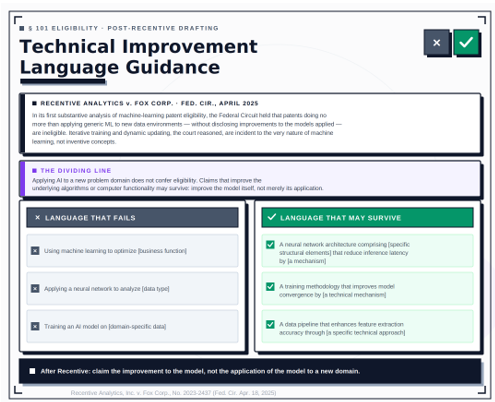
The April 2025 Federal Circuit decision in Recentive Analytics, Inc. v. Fox Corp., No. 2023-2437, 134 F.4th 1205 (Fed. Cir. 2025), the court’s first decision to address, as a question of first impression, whether applying generic machine learning to a new data environment is patent eligible, provides the clearest recent guidance on what does not work and, by negative implication, on what might.
Recentive’s patents used machine learning to optimize network maps and schedules for television broadcasts and live events. The Federal Circuit held that patents which do no more than apply generic machine learning to new data environments, without disclosing improvements to the models applied, are ineligible, and that iterative training and dynamic updating were incident to the very nature of machine learning, not inventive concepts.
The key concept is improvement to the machine learning models themselves. Simply applying artificial intelligence to a new problem domain, such as scheduling or optimization, does not establish eligibility. Claims that improve the underlying technology, however, may survive. The court’s reasoning implies that patents which improve the underlying algorithms or computer functionality may remain eligible.
Language that fails:
- Using machine learning to optimize [business function]
- Applying a neural network to analyze [data type]
- Training an AI model on [domain-specific data]
Language that may survive:
- A neural network architecture comprising [specific structural elements] that reduces inference latency by [mechanism]
- A training methodology that improves model convergence by [technical mechanism]
- A data pipeline that enhances feature extraction accuracy through [specific technical approach]
Specific Claim Language Patterns for Machine Learning
The USPTO’s July 2024 subject matter eligibility examples, Examples 47 through 49,[4] provide a model for eligible AI claims. Example 47 describes an application-specific integrated circuit for an artificial neural network, including an array of neurons, each with a register, a processing element, and interconnected synaptic circuits. That claim satisfies eligibility because it claims a specific hardware architecture, not abstract AI concepts.
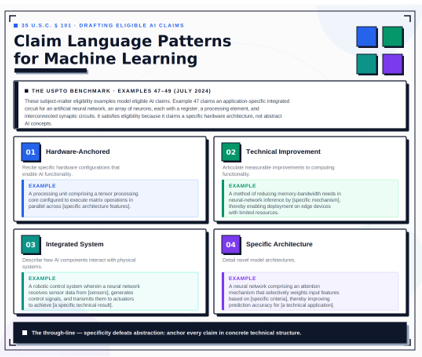
Pattern 1, hardware-anchored claims: Recite specific hardware configurations that enable AI functionality, for example, a processing unit comprising a tensor processing core configured to execute matrix operations in parallel across [specific architecture features].
Pattern 2, technical improvement claims: Articulate measurable improvements to computing functionality, for example, a method of reducing memory bandwidth requirements in neural network inference by [specific technical mechanism], thereby enabling deployment on edge computing devices with limited resources.
Pattern 3, integrated system claims: Describe how AI components interact with physical systems, for example, a robotic control system wherein a neural network receives sensor data from [specific sensors], processes the data to generate control signals, and transmits those signals to actuators to achieve [specific technical result].
Pattern 4, specific architecture claims: Detail novel model architectures, for example, a neural network comprising an attention mechanism that selectively weights input features based on [specific technical criteria], thereby improving prediction accuracy for [specific technical application].
What Recent Guidance Means for Your Patent Strategy
The August 2025 memorandum establishes that Section 101 rejections should be made only when it is more likely than not that a claim is ineligible. Close calls go to the applicant: examiners cannot reject merely because eligibility is uncertain, but must have affirmative evidence of ineligibility.
The memorandum also requires examiners to analyze claims as a whole rather than isolating individual components. When elements work together to produce a technological improvement, the claim integrates any abstract idea into a practical application, even if individual elements might appear abstract in isolation.
These developments, together with the direction the Office has signaled since Director John Squires took office in September 2025, suggest that eligibility examination should keep pace with rapidly developing fields.[5] The Office’s recent guidance on subject matter eligibility, together with the USPTO Appeals Review Panel decision in Ex parte Desjardins,[6] illustrates how these standards are applied in practice and is worth reviewing alongside the August 2025 memorandum.
For prosecution strategy: Reference the August 2025 memorandum explicitly when responding to Section 101 rejections, argue that claimed AI operations cannot practically be performed in the human mind, and emphasize how claim elements interact to produce technical improvements rather than letting examiners isolate them.
For drafting strategy: Focus specifications on technical problems and technical solutions. Explain how the AI system improves computing functionality, including processing speed, memory efficiency, and accuracy — not just business outcomes. Include robust dependent claims that add specific technical features.
The Black Box Problem: Avoiding Common Mistakes
AI patent applications frequently fail because they describe what the system achieves without explaining how it achieves it. This “black box” claiming style invites rejection from examiners looking for concrete technical mechanisms.
Do not claim: A method for using artificial intelligence to optimize traffic flow. This reads as an abstract business method.
Instead, claim: A method of traffic signal control comprising receiving sensor data from vehicle detection systems, aggregating the data into a feature matrix, applying a neural network model to generate weighted signal timing sequences, and updating traffic light timing to minimize average vehicle delay. The application must detail the specific technical mechanisms that produce the improvement.
The Bottom Line for Practitioners
While Section 101 remains challenging, the landscape for securing well-drafted AI patents at the USPTO is arguably more favorable today than at any point since Alice. The August 2025 memorandum's "more likely than not" standard, its insistence that claims be analyzed as a whole, and its recognition that AI operations may fall outside the mental-process category collectively lower the barriers that have frustrated applicants for a decade. Recentive, while narrowing the path for generic machine-learning-on-new-data claims, clarifies the path that remains open: claims directed to concrete improvements in the underlying technology.
For practitioners working with artificial intelligence innovators, the opportunity lies in how they engage with those innovators before a single claim is written. The most effective eligibility strategy is not a prosecution argument—it is a drafting conversation. That means pressing inventors to articulate the technical problem their system solves and then building a specification rich enough to support claims at multiple levels of abstraction. The application should explain not just what the AI does, but how it works and why that implementation represents a technical advance—such that the improvement would be apparent to someone skilled in the technology. When the specification reads like an engineering disclosure rather than a marketing summary, the claims that flow from it are far more likely to withstand eligibility challenges and to provide meaningful protection worth enforcing.
The difference between patent applications that provide meaningful protection and those that do not often lies in whether the claims articulate a genuine technological contribution or merely describe applying machine learning to a business problem. The current framework rewards claims that read like engineering manuals: specific architectures, concrete technical mechanisms, and measurable improvements to computing functionality. Claims that read like business aspirations—using AI to optimize a result—continue to fail. The burden remains on applicants to demonstrate genuine technical innovation. When applied faithfully, the current framework distinguishes between claims that advance the technology and those that merely invoke it.
[1]See Dancing with Abstract Ideas: Patent Eligibility in 2025, PatentDocs (June 9, 2025), https://patentdocs.org/2025/06/09/dancing-with-abstract-ideas-patent-eligibility-in-2025/. These figures reflect the cited author’s interpretation of Federal Circuit data and have not been independently verified by the firm.
[2]USPTO, Memorandum, Reminders on Evaluating Subject Matter Eligibility of Claims Under 35 U.S.C. § 101 (Aug. 4, 2025) (Kim memorandum), https://www.uspto.gov/sites/default/files/documents/memo-101-20250804.pdf.
[3]MPEP § 2106 (9th ed., latest rev.) (setting forth the Office’s subject matter eligibility analysis under the Alice/Mayo framework).
[4]USPTO, 2024 Guidance Update on Patent Subject Matter Eligibility, Examples 47–49 (July 2024), https://www.uspto.gov/sites/default/files/documents/2024-AI-SMEUpdateExamples47-49.pdf.
[5]USPTO, USPTO Issues New Guidance on Subject Matter Eligibility Declarations (Dec. 4, 2025), https://www.uspto.gov/subscription-center/2025/uspto-issues-new-guidance-subject-matter-eligibility-declarations.
[6]Ex parte Desjardins, Appeal No. 2024-000567 (PTAB Sept. 26, 2025) (Appeals Review Panel decision) (precedential Nov. 4, 2025), https://www.uspto.gov/sites/default/files/documents/202400567-arp-rehearing-decision-20250926.pdf.
Tim Bright, Managing Partner, Bright-Line IP, Patent Agent
Tim has a deep understanding of IP law gained through over 10 years of experience working roles including Director of Patent Prosecution for a startup patent firm, Patent Agent within an AMLaw 100 firm, and Patent Analyst preparing International Search Authority opinions.
Tim's practice focuses on IP matters related to AI, Robotics and Semiconductor Manufacturing. Additionally, he has experience working with technologies including 5G/wireless communication, internet of things devices, self-driving cars, and electronic sports equipment.
Innovate Volume 21 Timeline
submit articles to innovate@aipla.org
Submission Window Open
August 5, 2026
Submission Deadline
October 30, 2026
Publication Date
December 11, 2026
About
Publishing an article to INNOVATE is a great way for AIPLA members to build their brand by increasing recognition among peers and setting themselves apart as thought leaders in the IP industry.
Any current AIPLA member in good standing may submit an article for consideration in INNOVATE throughout the year. IP law students are especially encouraged to submit articles for publication.
Articles submitted to innovate@aipla.org are reviewed by an ad-hoc sub-committee of volunteers from AIPLA's Fellows Committee, and other AIPLA peers.
Don’t miss your chance to be published with AIPLA’s INNOVATE! Email your article submission to innovate@aipla.org to be considered for the next edition.
For more information please review the Guidelines for INNOVATE Article Submission and the INNOVATE Author Acknowledgement Letter for guidelines and terms of article submission and publication.